Class blog for A2 Media Studies research and assignment information.

Wednesday, September 23, 2026

Other exam concepts and preparation


GATEKEEPING


Gatekeeping is the process of deciding what information gets selected, prioritised, changed or excluded before reaching an audience.


OLD MEDIA

Journalist

Editor

News organisation

Audience

DIGITAL MEDIA

User

Platform

Algorithm

Audience

But also:

Audience

shares/comments

algorithm

more users

So the audience becomes part of the gatekeeping process.


Who is the gatekeeper now?


Who is the gatekeeper now?

Students can discuss:

  • journalists
  • editors
  • media owners
  • governments
  • regulators
  • algorithms
  • platforms
  • influencers
  • audiences

This links well to:

Curran & Seaton → ownership

McCombs & Shaw → agenda-setting

Livingstone & Lund → regulation

Shirky → audience power

Hall → reception


3. ALGORITHMIC POWER

You have touched this several times, particularly in your Clancy/true-crime work and public discourse material, but I would turn it into a proper examinable concept.

Your September material already identifies algorithmic power as useful terminology and discusses how short-form platforms can reward sensational content and engagement. 

Give them this chain:

Algorithmic power = the ability of platforms' automated systems to influence what users encounter, engage with and potentially ignore.

Then:

Algorithm

→ selects content

→ increases visibility

→ influences engagement

→ shapes audience experience

→ potentially influences discourse.

But immediately teach the counterargument:

Algorithms do not necessarily determine what audiences believe.

Audiences can:

  • scroll
  • reject
  • search elsewhere
  • follow alternative sources
  • create their own content
  • challenge dominant narratives.

Theory connections

Shirky

Audience becomes producer.

Hall

Audiences decode differently.

Agenda-setting

Visibility influences what receives attention.

Gatekeeping

Algorithms become new gatekeepers.

Hegemony

Repeated messages can normalise particular ideas.

That gives them a fantastic theoretical chain.


4. POST-TRUTH + MISINFORMATION

This is the biggest Power & Media / Regulation crossover that I think would strengthen the final preparation.

Your blog has touched this through Trump/social media, true crime, algorithms and regulation, but I would formalise it.

Teach these distinctions:

Misinformation

False information shared without necessarily intending to deceive.

Disinformation

False information deliberately created or distributed to deceive.

Malinformation

Genuine information used in a misleading or harmful context.

Then connect this to:

  • social media
  • algorithms
  • political communication
  • citizen journalism
  • AI
  • deepfakes
  • clickbait
  • sensationalism
  • echo chambers
  • confirmation bias.

Excellent debate

Does digital media democratise information or undermine reliable information?

That single question can generate material for:

  • Power & Media
  • Media Regulation
  • Media Ecology

5. PLATFORM CAPITALISM

This is probably the most useful newer concept for your students.

Your blog already lists platform capitalism in the September terminology bank. 

But I would actually teach it.

Simple definition

Platform capitalism describes the economic model in which digital platforms generate value by controlling digital infrastructure, data, attention and interaction.

Students can then understand:

Users

create content

Platforms

collect data / attention

Algorithms

organise content

Advertising

monetises attention

Platforms

gain economic and cultural power.

This is a much more sophisticated way of talking about TikTok, YouTube, Facebook, Netflix etc. than simply saying:

"Technology has changed media."


6. CONVERGENCE

You've used convergence throughout the year, but I'd make students explicitly understand it as a synoptic concept.

Technological convergence

One device performs multiple media functions.

Media convergence

Different media forms/platforms overlap.

Industrial convergence

Companies operate across multiple media industries.

Cultural convergence

Audiences participate across multiple media platforms.

Then give them:

Black Panther

Film

Disney

cinema

streaming

social media

YouTube

fan communities

merchandise

global audience

Suddenly one case study can answer multiple questions. 

Media Ecology - bringing concepts together


THE REALLY IMPORTANT GAP: SYNOPTIC THINKING

This is where I would spend most of your final two lessons.

The syllabus explicitly says Media Ecology is synoptic, requiring students to synthesise language, representation, industry and audience and apply this to contemporary examples from at least two media forms. 


Case studyLanguageRepresentationIndustryAudience
Disneynarrative, genre, brandinggender/cultureownership/conglomeratefandom
Black Panthergenre, visual languageAfrican identityDisney/Marvelglobal audience
TikTokshort-form conventionsuser representationplatform capitalismparticipatory
Netflixstreaming conventionsdiverse contentglobal institutionactive audience
Sound of Freedomgenre/rhetoricideological representationcrowdfundingparticipatory audience
The Chosennarrative/brandingreligious identitycrowdfundingaudience demand
NZ Māori medialanguage/conventionsindigenous representationNZFC/NZ On AirNZ audiences
True crime/TikToksensationalismrepresentation of real peopleplatform economyalgorithmic audience

That table is gold for the final lessons.

Tuesday, September 22, 2026

T3 | Wk 10 | Wed | Social Media - new media impacting traditional media


Social Media overtaken traditional news outlets 

https://www.youtube.com/watch?v=AgIuRXdZle0


- Make some notes about the shift from traditional media to social media as a new platform 

- What issues are raised with this trend in this clip? 

- how are younger audiences engaging with news content? 


Social media impact on film marketing 

https://www.filmfrog.com/frog-blog/social-medias-role-in-modern-movie-marketing


- how is this seen in your case study movies? 


Do some research and make some lists of ways that social media has DISRUPTED more traditional audiences trends and ways of interacting with media. We will report back to the class in tomorrow's lesson. 

Media Ecology - further audience research based on Meta data


https://www.forbes.com/advisor/business/social-media-statistics/

T3 | Wk 10 | Wed - Media Ecology Question

 Today we are going to explore this question;


  ‘The media have transformed us into global citizens.’ To what extent do you agree with this


Monday, September 21, 2026

T3 | Wk 10 | Wednesday - past question approach

 Question 1 Assess the extent to which public discourse is controlled by the media.

 Cambridge rewards responses that recognise:

  • complexity
  • competing viewpoints
  • theory
  • case studies
  • audience agency
  • changes caused by digital media
  • evaluation of different forms of power

A strong argument is:

The media has significant power to influence public discourse through agenda-setting, representation, ownership and rhetoric, but this control is never absolute because governments, audiences, social media users and alternative media can challenge, negotiate and reshape dominant meanings.


Breaking down the question

Key term: Public discourse

Public discourse refers to:

The conversations, ideas, debates, values and issues that circulate in society.


Examples:

  • climate change
  • immigration
  • crime
  • elections
  • gender
  • war
  • economic issues
  • national identity
  • health
  • social justice

Media can influence:

  • what issues are discussed
  • how issues are framed
  • who gets to speak
  • whose voices are excluded
  • which ideas become normalised

Define the concept:

Public discourse refers to the ways issues, events and ideas are discussed within society. Media institutions have historically exercised considerable power over discourse through ownership, representation, agenda-setting and rhetoric. However, digital media and audience participation have complicated traditional models of control. Therefore, while media organisations continue to shape public discussion, their influence is contested and negotiated rather than absolute.

Introduction

Define:

  • public discourse
  • media power

State debate:

Media institutions significantly influence public discourse through agenda-setting, representation and ownership structures, but control is increasingly contested by audiences, digital media and alternative voices.


Key Debates

Students should frame essays around these tensions:

Debate

Question

Ownership

Who controls media?

Algorithms

Who controls visibility?

Audiences

Are people passive or active?

Platforms

Do social media democratise discourse?

Hegemony

Are dominant ideas normalised?

Resistance

Can audiences challenge narratives?


Useful Theories 

1.    Curran and Seaton

Media ownership matters.

Large organisations possess:

  • resources
  • distribution networks
  • political influence

This gives some institutions greater power over discourse.

Examples:

  • Disney
  • News Corp
  • Meta
  • Google

Evaluation

The internet allows smaller voices to enter debates.

2.     Stuart Hall – Encoding/Decoding

Media producers encode preferred meanings.

Audiences may:

Dominant reading

Accept.

Negotiated reading

Partly accept.

Oppositional reading

Reject.

Evaluation

This challenges the idea of total media control.

3.     Gramsci – Hegemony

Dominant groups maintain influence by making ideas appear:

  • natural
  • normal
  • common sense

Media contributes through repeated representations.

Example:

Repeated associations between:

  • success and wealth
  • consumerism and happiness
  • economic growth and progress

Evaluation

Alternative media can challenge dominant ideologies.


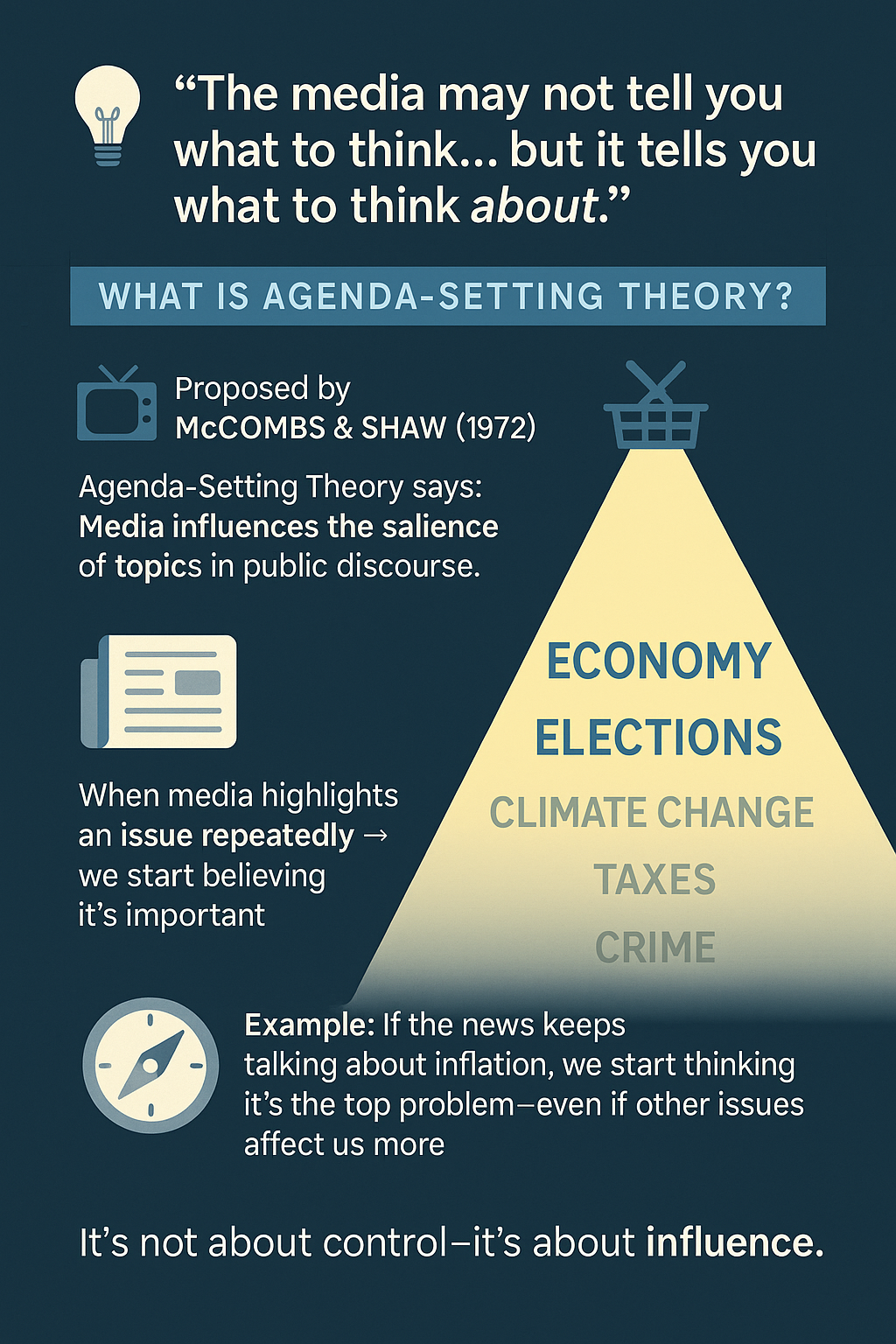
4.     McCombs and Shaw – Agenda-Setting

Media may not tell audiences what to think, but can influence:

what people think about.

Example:

Heavy coverage of:

  • immigration
  • inflation
  • climate change
  • crime

can elevate these issues within public discussion.

Evaluation

Digital media means audiences increasingly influence agendas through:

  • social media trends
  • hashtags
  • citizen journalism


5.     Shirky – End of Audience

Digital media has shifted audiences from:

consumers

to:

participants.

Audiences:

  • create content
  • comment
  • share
  • challenge institutions

Evaluation

Platforms still retain power through algorithms.


Useful Terminology

Students should include:

  • public sphere
  • discourse
  • hegemony
  • ideology
  • agenda-setting
  • framing
  • gatekeeping
  • representation
  • rhetoric
  • audience agency
  • algorithmic power
  • media ownership
  • participatory culture
  • preferred meaning
  • oppositional reading
  • prosumer
  • convergence
  • platform capitalism


Useful Examples 


1.     COVID-19 Communication

Government communication:

  • daily briefings
  • social media
  • news coverage

created dominant narratives.

Evaluation:

Alternative media and online discussion also influenced discourse.


2.     Black Lives Matter

Shows:

Media power

News organisations framed events.

Audience power

Users created:

  • videos
  • posts
  • hashtags

Public discourse became contested rather than controlled by one institution.

Excellent example for:

discourse as negotiation.

3.     Facebook and the 2016 US Election

Concerns around:

  • misinformation
  • targeting
  • algorithms

Illustrates:

platforms can influence which information circulates.

Evaluation:

Audiences still choose whether to engage.


Sunday, September 20, 2026

T3 | Wk 10 | Tuesday - Power and the Media - Agenda Setting Theory

Agenda-setting theory


Agenda setting of mass media - McCombs & Shaw - Presentation | PDF


Medium


Agenda-setting theory was formally developed by Maxwell McCombs and Donald Lewis Shaw in a study on the 1968 US presidential election, "the Chapel Hill study". McCombs and Shaw demonstrated a strong correlation between one hundred Chapel Hill residents' thought on what was the most important election issue and what the local news media reported was the most important issue. 

Agenda-setting theory suggests that the communications media, through their ability to identify and publicize issues, play a pivotal role in shaping the problems that attract attention from governments and international organizations, and direct public opinion towards specific issues. The theory suggests that the politician and journalists can shape public opinion through media by determining what issues are given the most attention, and has been widely studied and applied to various forms of media. The way news stories and topics that impact public opinion are presented is influenced by the media. It is predicated on the idea that most individuals only have access to one source of information on most issues: the news media. Since they establish the agenda, they may affect how important some things are seen to be.

The agenda-setting by media is driven by the media's bias on things such as politics, economy and culture, etc. Audiences consider an issue to be more significant the more media attention it receives (media issue saliency). For instance, even if readers do not have strong feelings about immigration, they might believe that it is a pressing problem at the time if there is consistent journalistic coverage of it over the period of a few months.

The theory has two core assumptions. The first is that it is the media that controls the reality. The media does not report the reality but instead filters and shapes it. The second assumption is that it is the media that gives importance or saliency to its topics as the more likely the media focuses on certain issues, the more likely the public perceive such issue as important and therefore demands action.

Research has shown that the media's persistent coverage of particular issues can lead to heightened public interest and demand for action, thereby influencing public opinion and even policy outcomes. Notably, events like the Watergate scandal illustrate the theory's relevance, as extensive media coverage played a crucial role in shaping public scrutiny of President Nixon, ultimately leading to his resignation.


In the modern context, the rise of social media has transformed the landscape of agenda setting, allowing for a more direct dialogue between public figures and citizens, while also challenging traditional media’s gatekeeping role. This evolution underscores the continuing significance of agenda-setting theory in understanding communication dynamics and public discourse across diverse cultural contexts.


Activity


Write a paragraph in response to the following question, using the Agenda Setting theory and include a relevant example that we have studied in class. 


"Assess the extent to which public discourse is controlled by the media"

Other exam concepts and preparation

  GATEKEEPING Gatekeeping is the process of deciding what information gets selected, prioritised, changed or excluded before reaching an aud...